
Want to hit the road with your camper? We love to hear that! But wait a minute. Before you tear down the highway, we want to touch on something important: road tax for 2024. It may sound like a dry topic, but trust us, it's good to read up on it. Then you can set off on your adventure without any worries.
Curious about how to arrange road tax for motorhomes? We explain everything in this blog.
Paying road tax
Whether you drive a lot or a little, the amount of road tax, also known as motor vehicle tax or MRB, varies for everyone. Various factors play a role in determining the amount of this tax. For example, the province where you live, how much CO₂ your motorhome emits, the type of engine, and the weight of the motorhome all contribute to the final price of your MRB.
Three options for motorhome road tax
Road tax rates are set annually. It is advisable to check the current rates regularly to avoid unpleasant surprises. There are currently three options for motorhome travelers:
You do not pay road tax for motorhomes that are 40 years old or older. This is particularly relevant for vintage motorhome enthusiasts.
For campers under the age of 40, you pay a special rate: the so-called quarter rate. During four consecutive periods (one year), you pay road tax once. This amounts to a 75% reduction in road tax.
For campers that you rent out commercially, you pay half the rate. You only pay motor vehicle tax twice a year. This amounts to a 50% reduction in road tax.
Special rate for motorhomes
Because campers and motorhomes are usually only used a few times a year, they are subject to a more favorable (lower) motor vehicle tax rate. This special rate of 25% for campers less than 40 years old is a great way to save money. Your camper must be registered as a 'camper van' on the registration certificate and your vehicle must comply with the interior requirements of the Dutch Vehicle Authority (RDW) and the Tax and Customs Administration.
To take advantage of this special rate, the interior of the motorhome really needs to look like a home on wheels.
RDW requirements for motorhome registration
A converted camper van must be inspected by the RDW. During the RDW inspection, the RDW assesses the camper van for all kinds of modifications. If the van then meets these requirements, the RDW registers the van as a camper van.
The RDW has strict safety requirements. Parts must be properly installed so that they do not shift while driving or cause accidents. The RDW also monitors the safety of seats. Swivel platforms and seat belts must have a certificate proving that the fastenings comply with European standards.
IDEAL! We build our Overland Campers to meet the latest interior and safety requirements. This prevents your camper from being rejected. On request, we can arrange the RDW inspection of your camper and keep you informed of the approval and associated registration.
Would you like to know more about the RDW's interior requirements? Read here the latest information about getting your van approved as a camper van.
Interior requirements for motorhomes Tax Authority
Have you received approval from the RDW? Then it is now time to apply for a special rate from the Tax and Customs Administration. You can only apply for this rate after your motorhome has been approved by the RDW, because you will need the weight of the motorhome when submitting your request.
It is important that your motorhome meets the interior requirements of the Tax and Customs Administration in order to benefit from the lower motor vehicle tax. That is why we have already compiled the most important points for you!
We refer to a camper as:
the interior space is suitable for human habitation and transport
a permanent cooking and sleeping area is available
that meets the design requirements of the RDW and the Tax and Customs Administration
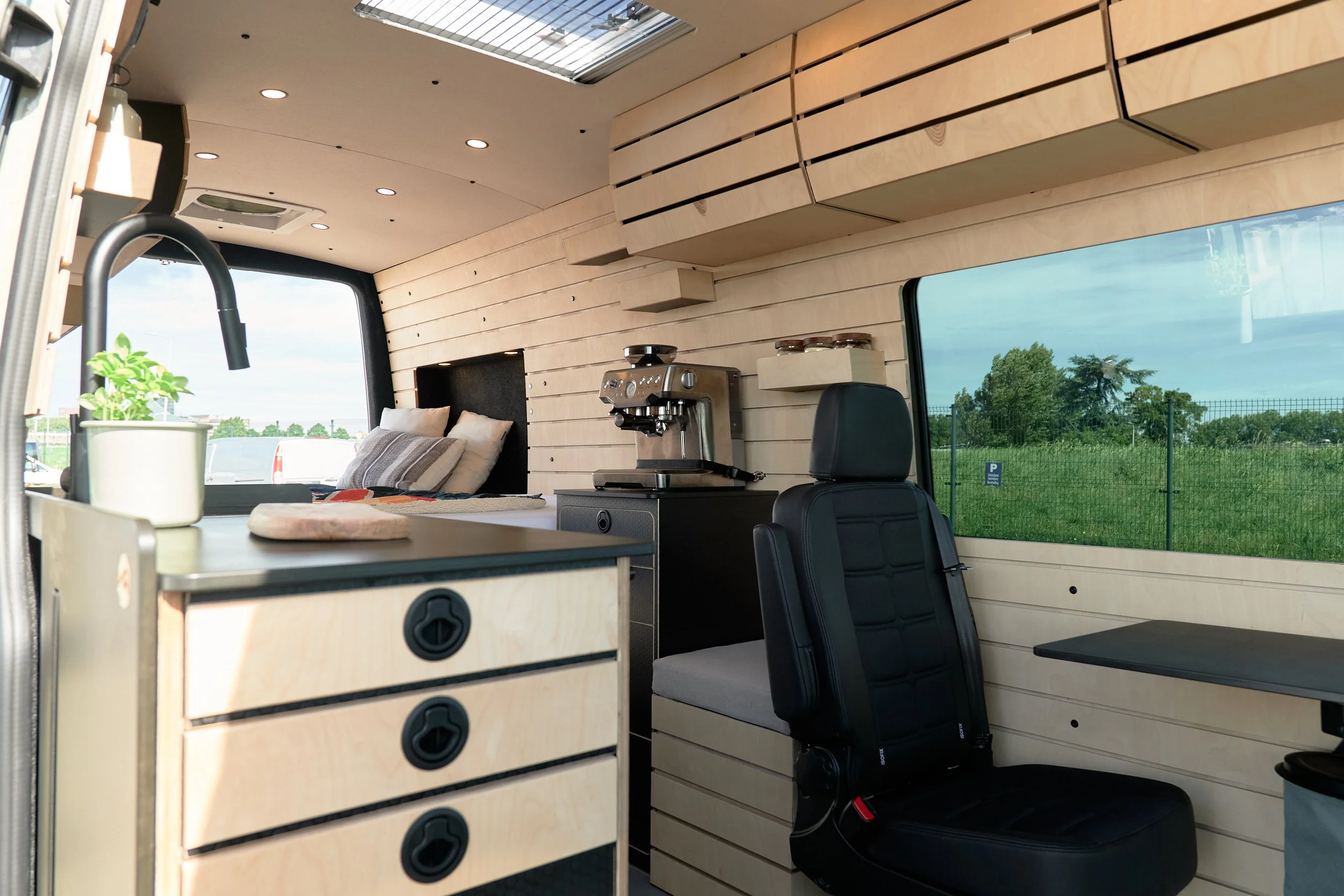
The camper van must have an interior space that appears to be a rectangular block. This refers to the interior space behind the driver's and passenger's seats. This space must be at least 170 cm high, 200 cm long, and 90 cm wide.
In addition, a motorhome must have the following:
At least two fixed seats. If these are the driver's and passenger's seats, the seats must be able to swivel toward the interior.
A fixed table that you can remove if necessary.
A fixed kitchen unit in the interior with a worktop that is at least 60 cm high. This unit also has a built-in (removable) water supply with sink, tap, and drain.
A permanent cooking facility in the interior (e.g., a microwave).
At least 2 fixed and lockable storage modules.
A sleeping place for at least two people. This can be a fixed bed or a bed that you make by moving seats.
A double bed is at least 180 cm long x 110 cm wide. If you have two or more separate beds, they must be at least 180 cm long and 60 cm wide to provide at least two sleeping places.
If your motorhome meets these requirements, you can use this form and apply for the campervan rate. Please include photos of the campervan interior with your application to show that your campervan meets the interior requirements.
Not sure whether your motorhome meets the interior requirements? Always check the website of the Tax and Customs Administration website for the most recent requirements and changes.
Camper as a commercial vehicle
A commercial vehicle is defined as a vehicle with four or more wheels, which is not a limited-speed motor vehicle or a vehicle for the disabled, and which is equipped for the transport of goods or the performance of other work. In any case, a vehicle in vehicle category 'N' can be a commercial vehicle. A vehicle that is already listed as a commercial vehicle in the vehicle registration register also counts.
Do you need a delivery van for your business? Then it is useful to know whether the company car is also classified as a delivery van by the tax authorities. A delivery van must comply with certain rules for road tax purposes. The car is primarily intended for transporting goods.
The cargo area must have a flat floor across its entire width and length. There must be no seats in the cargo area. The vehicle may weigh a maximum of 3,500 kilograms, including the weight of the vehicle itself, the people inside, and the cargo. There are also rules governing how the vehicle is converted and equipped.
Would you like to take advantage of the benefits of using a camper as a commercial vehicle for vehicle tax purposes? Good news! An Overland Camper meets these requirements. Discuss your wishes with us and we will find the best balance between camper and commercial vehicle.

Can also be used as a company vehicle.
Calculate road tax for motorhome
Want to calculate the road tax for your motorhome? Fortunately, Independer has a handy calculation tool to find out how much road tax your motorhome will cost. Go to the website, use the easy calculation tool and voilà, you'll know exactly what you'll be paying.
Save money: temporarily suspend your camper registration
If you are not going to use your motorhome for a while, for example during the winter months or if you do not have any trips planned, you can apply for a suspension at the RDW. The advantage of suspending the license plate is that you do not have to pay road tax during this period. In addition, the mandatory third-party liability insurance and MOT inspection are not required during the period that your motorhome is suspended.
Suspending your license plate means that your camper van is no longer allowed on public roads. Driving the camper van is also not allowed. There is one exception, however. If you are taking the suspended camper van for its MOT test, you are allowed to drive it around the time of the MOT appointment. But only on the shortest route between the address where the camper van is parked and the MOT station.
To avoid paying road tax, your motorhome must be suspended for at least one month. If you lift the suspension within one month, you will still have to pay tax for that period, unless you sell the motorhome within one month of suspension.
You can apply to the RDW to suspend your motorhome for 1, 2, or 3 years. This is also possible for shorter periods. If you want to end the suspension earlier, you must do so before the period expires. The suspension takes effect immediately and expires automatically, unless you apply for an extension. We advise you to keep a close eye on the end date of the suspension. After that date, you must immediately comply with obligations such as car insurance, MOTs, and road tax.
There are costs associated with suspending the motorhome license plate. Here are the costs for 2024:
For campers up to 15 years old: €88.05
If you suspend a motorhome up to 15 years old within 1 year of the start of the previous suspension: €88.05
For all other campers: €29.10
If you want to extend the suspension: €29.10
Lifting the suspension is free of charge.
Applying for a suspension can be done quickly and easily online. The suspension takes effect immediately and, after applying, you will receive a confirmation letter and a certificate of registration with the end date of the suspension from the RDW within a few working days. Suspend your motorhome online now.


Pay road tax on time
Be on time with paying your road tax! By doing so, you will not only avoid unnecessary costs, but also possible fines. The Tax and Customs Administration considers late, incomplete, or non-payment of your road tax to be a default. You will then receive a bill for the missing amount, as well as a fine, depending on your specific situation.
If you pay late again within a year of a previous late payment, you run the risk of a fine of €55. In exceptional cases, this fine can even amount to a maximum of €5,514 per late payment.
It is therefore important to comply with the conditions set and to submit a correct declaration. You must also ensure that your vehicle is not used on the road during a suspension and that you report any changes to your motorhome, such as weight or fuel, in good time.
Important changes to motorhome road tax legislation
Last year, the government announced a new tax plan on Prinsjesdag. An important part of this plan is that the quarter rate will disappear from January 1, 2026. Until then, motorhome owners will pay a quarter of the normal tax. After January 1, 2026, this rate will be increased to half (50%) of what you would pay for a regular passenger car.
If you currently rent out your motorhome for business purposes, you already pay 50% tax. This arrangement will remain in force for rental companies in 2026.
As soon as you make changes to your camper, the rules that apply to it may also change. For example, a delivery van may suddenly be considered a passenger car, or vice versa. That is why we recommend that you always stay up to date with the latest changes and developments for peace of mind.
Stay up to date and ask for advice!
Would you like to stay up to date on everything related to road tax for motorhomes? We are here to answer any questions you may have.
Do you have a question about this blog? Please contact us.
In any case, make sure you keep an eye on any changes. That way, you'll always be well informed and can set off on your adventure with peace of mind!
